
B-Act®: A New Technical Bulletin In Challenging Diets
Dennis SmuldersThe post-weaning period is a critical phase in pig production, often characterised by nutritional and physiological stress. This challenge becomes even more pronounced when diets are formulated with reduced crude protein levels or rely less on highly digestible, functional raw materials. In practice, such "challenging diets" are designed without ingredients like plasma powder, fishmeal, whey powder, haemoglobin, or live yeast, while also lowering overall crude protein content.
In the present evaluation, the positive control (PC) group received a standard, high-quality diet including live yeast, haemoglobin, plasma powder, fishmeal, and whey powder. In contrast, both the negative control and the B-Act® groups were fed diets with reduced protein levels and protein quality: crude protein levels were 0.5-1.4% lower (depending on the feeding stage) compared to the PC, and there was no inclusion of the above-mentioned high-quality functional ingredients. This feeding strategy reflects an internationally severe nutritional challenge, going beyond standard field conditions to clearly demonstrate the importance of gut support.
Under these conditions, the immature digestive system of the piglet is less equipped to cope with dietary complexity, increasing the risk of dysbiosis, proliferation of undesirable bacteria, and intestinal disturbances such as diarrhoea. This can ultimately lead to reduced growth performance and less uniform batches.
B-Act® is a probiotic feed additive based on a spore-forming strain of Bacillus licheniformis (DSMZ 28710), specifically selected for its robustness and functionality in the gastrointestinal tract. Its spore form ensures stability during feed processing and allows it to reach the intestine intact where it becomes metabolically active.
Once active, B-Act® supports gut health through multiple complementary mechanisms. A key mode of action is competitive exclusion; whereby beneficial bacteria occupy ecological niches and limit the establishment and proliferation of opportunistic or pathogenic microorganisms. In addition, B-Act® contributes to the direct inhibition of undesirable bacteria, helping to stabilise the microbial balance in the gut. Together, these effects promote a more resilient intestinal environment.
A recent technical evaluation (TB12 - link below) investigated the role of B-Act® in piglets receiving such nutritionally challenging diets under commercially relevant conditions. In this study, significantly higher body weight at 12 and 21 days post-weaning were observed compared to the negative control group (Figure 1).
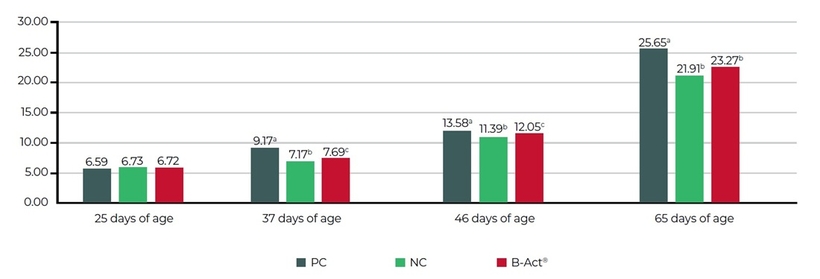
Figure 1. Weight at weaning (day 25) and at 37, 46 and 65 days of age. The positive control (PC) group received a standard feed including live yeast, haemoglobin, plasma powder, fishmeal and whey powder. All other groups were fed a lower protein level diet, no live yeast, no haemoglobin, no plasma powder, no fishmeal and no whey powder. Diet composition is available on request. Different letters mean a significant difference at p<0.05.
In addition, B-Act® supplementation increased daily feed intake by approximately 40 g per piglet during the first 40 days post-weaning, while also contributing to improved gut health, as reflected by lower diarrhoea scores (Figure 2).
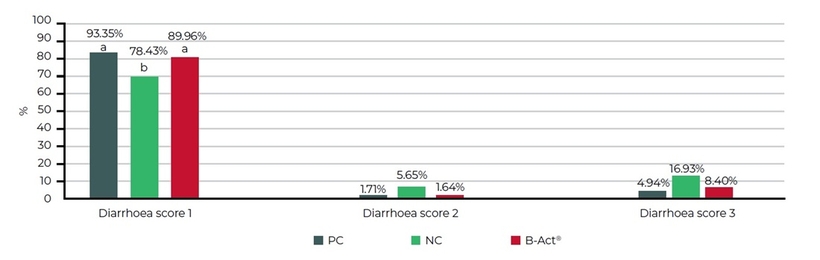
Figure 2. Diarrhoea scoring at day 37 (12 days post weaning). Different letters mean a significant difference at p<0.05.
The findings underline that supporting the gut microbiota becomes even more critical when dietary quality is compromised. By reinforcing microbial balance and intestinal stability, B-Act® helps piglets better cope with these challenges during the immediate post-weaning phase.
With its proven stability, ease of use, and compatability with a wide range of feeding programmes, B-Act® offers a practical nutritional tool to maintain gut health and support performrance in modern swine production systems.