
Getting The Most Out Of Feed By Optimising Fibre Degradation In Broilers
Natalia SoaresNon-starch polysaccharides (NSPs) account for 10-12% of the dry matter in broiler diets. These NSPs contain some anti-nutritive factors that impair feed utilisation, reducing nutrient digestibility and absorption through the gastrointestinal tract (GIT).
Feed utilisation is impaired because of the presence of soluble (arabinoxylans (AX), glucans) and insoluble (AX, cellulose) NSPs which may:
- increase digesta viscosity
- limit nutrient absorption
- promote pathogen growth in the GIT
- limit endogenous enzyme access to nutrients trapped in the cell wall matrix
NSP-degrading enzymes (NSPases) are considered best practice in broiler nutrition, enhancing feed digestion and contributing to improved animal performance. The use of NSPases also contributes to a significant reduction in feed cost as their action allows nutrient sparing effects and the use of alternative raw materials in feed formulation.
The NEW NSPase, Huvezym® neXo, is an enzymatic complex of 1,4-beta-xylanase; 1,4-beta-glucanase and xyloglucanase. Various research trials have shown the efficiency of Huvezym® neXo in improving the performance of animals fed different types of diets, including those containing more complex fibre or more fibrous raw materials.
The reported performance improvement with Huvezym® neXo is linked with its efficiency in degrading soluble AX and glucans which reduces intestinal viscosity and enhances nutrient absorption. It partially degrades insoluble NSPs present in the cell wall matrix, releasing nutrients that were physically entrapped by the cell wall. The previous actions are further enhanced by the presence of xyloglucanase which hydrolyses the xyloglucan cross linked between the cellulose fibres. The action of the three enzymes together results in a more efficient degradation of the cell wall.
The efficiency of Huvezym® neXo in degrading complex fibre is shown in Figure 1 where significant fibre digestibility improvements an be seen both for cellulose and hemicellulose in broilers fed a maize, wheat, soybean meal (SBM) diet. Due to the high arabinoxylan polymerisation degree of maize, diets formulated with >20% maize are classified as complex fibre diets.
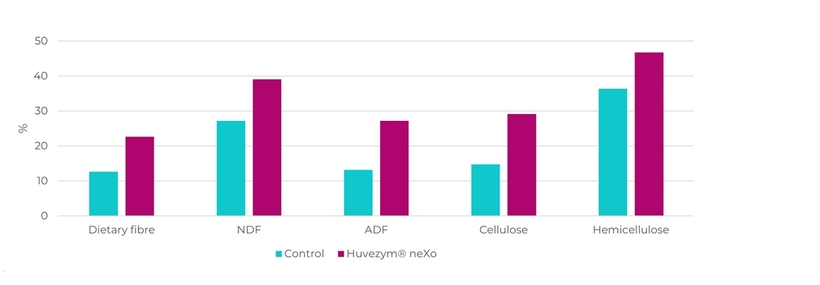
Figure 1. Effect of Huvezym neXo on fibre degradation: digestibility trials of broilers fed complex diets
NDF = neutral detergent fibre, ADF = acid detergent fibre
Market experience gathered from customers around the world (EU and non-EU countries) and extensive Huvepharma® research validates Huvezym® neXo as a unique nutritional tool for complex fibre challenges. Monogastric animals take advantage of the enzymatic breakdown of anti-nutritional factors and turn it into improved performance or equivalent performance at lower feed costs.
Figure 2 summarises performance improvements compared to a control diet in terms of final body weight and feed conversion parameters in broilers from four broiler grow-out trials, each using a different diet with a different level of fibre complexity (level of soluble NSPs, degree of polymerisation of arabinoxylan). The results show that as the level of soluble NSPs in the diet increases (wheat/barley) or as the degree of polymerisation increases (maize diets), the magnitude of the effect of Huvezym® neXo also increases. This validates the described mode of action and opens the door to various reformulation strategies, including the use of alternative raw materials or reformulating diets at a lower cost while maintaining performance.
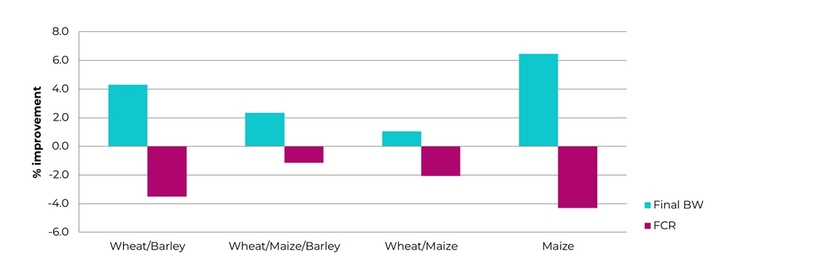
Figure 2. Performance improvements compared to a control group in terms of final body weight (BW) and feed conversion rate (FCR) in four broiler trials each using a different diet
Conclusion
Huvezym® neXo is a validated nutritional tool which enables broilers to get the most out of fibre, especially when complex fibre is part of the diet formulation. Its efficiency is reflected in improved animal performance and a healthier gut.
In addition, Huvezym® neXo is a tool for more cost-effective feed formulation, allowing the use of alternative feedstuffs without compromising animal performance.