
Huvezym® neXo Outperforms Competitors In A Customer Broiler Trial
Natalia SoaresBroiler diets are increasingly formulated with tighter nutrient margins, reduced mineral phosphate inputs and more aggressive enzyme nutritional matrices. In this context, the nutritional relevance of fibre-degrading enzymes is not restricted to viscous wheat or barley diets; even maize-soybean meal formulations contain cell-wall structures that can limit nutrient access and reduce the value of the diet. In maize-based feeds, arabinoxylans remain present in the cereal fraction, while soybean meal contributes with cellulose- and xyloglucan-rich dicot cell walls that can encapsulate nutrients and slow digestive access to it.
A broader carbohydrase concept can be advantageous in monogastric nutrition: xylanase addresses cereal arabinoxylans, cellulase contributes to the disruption of structural fibre, and xyloglucanase helps open dicot-derived cell-wall matrices, especially those associated with soybean products. Huvezym® neXo is an enzymatic complex containing these three activities.
To assess Huvezym® neXo efficacy, a leading integrator from Jordan conducted a 28-day broiler trial where multiple commercial enzyme products were compared on a reduced-nutritional matrix diet.
Trial description
The trial was conducted in a broiler house on a farm belonging to a leading integrator in Jordan. The house had floor pens installed for the trial birds, and loose birds were placed to fill the house capacity to help replicate commercial conditions. The trial ran over 28 days using seven treatments. Birds were placed at 100 birds per pen with eight replicates per treatment. The treatments were:
- Control
- Negative control
- Product A
- Product D
- Product E
- Product E+
- Huvezym® neXo
The negative control diet was formulated without fibre-degrading enzymes, and with a reduction of 100 kcal/kg energy and a reduction in amino acids corresponding to the Huvezym® neXo nutritional matrix. All test enzymes were evaluated over the top of the negative control diet, with the trial objective to assess which products could compensate for the dietary reductions and support bird performance to achieve the same performance results as the control group birds. OptiPhos® Plus phytase was included at 1500 FTU in all treatments, using matrix values for calcium, available phosphorus and sodium.
Dietary context and expected NSP substrates
The diets were maize- soybean meal-based and formulated into a three-phase feeding program: starter, grower and finisher (Table 1). Relative to the control group, the negative control diet had reduced soy oil inclusion and metabolizable energy was reduced by 100 kcal/kg in each phase, without changing crude protein content. Regarding substrates, maize contributes insoluble arabinoxylans, and soybean meal contributes cellulose and xyloglucan-rich cell-wall material.
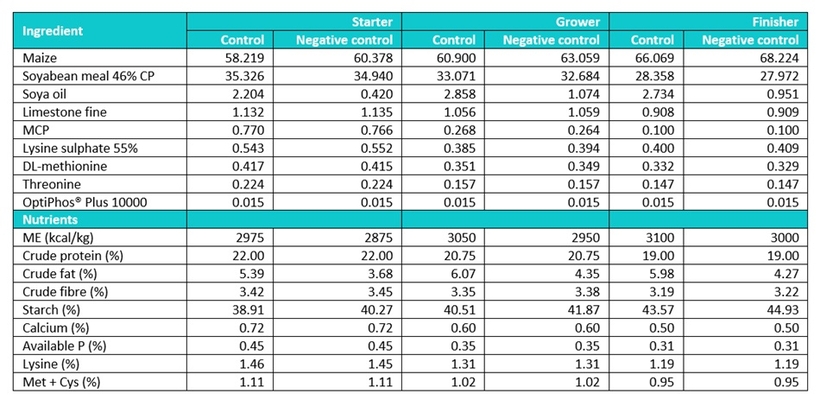
Table 1. Basal diet composition across phases (%)
Results and discussion
Performance response results are shown in Table 2. Huvezym® neXo delivered the highest day-28 body weight of the trial, averaging 1.944 kg per bird. This was +0.46% compared to the control group and +5.01% compared to the negative control group. At the same time, feed conversion rate (FCR) for the Huvezym® neXo group was 1.292, which was only +0.35% relative to the control group but an improvement of 3.07% compared to the negative control group. Total feed intake was 2.511 kg per bird, corresponding to +0.84% compared to the control group and 1.87% compared to the negative control group. Taken together, these values indicate that Huvezym® neXo did not simply stimulate feed intake; rather, it converted a modest increase in intake into the strongest weight response of the study while largely maintaining feed efficiency.
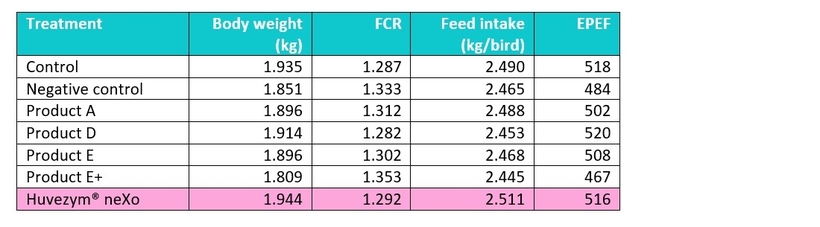
Table 2. Performance outcomes at day 28
Interpretation of the response
The trial compared all products in the same conditions. The nutritional question is not simply which product gives the lowest FCR, rather it should be which product most effectively recovers lost nutrient density (by reformulation of the negative control diet) and transforms recovery into body weight. Huvezym® neXo not only fully recovered the body weight 'penalty' of the negative control diet, but it also exceeded the control group by 0.46% and outperformed all other products. Even against the product with the best FCR (product D), the difference for Huvezym® neXo was only +0.75%m suggesting that the extra weight was achieved with only a small efficiency trade-off. In practical terms, this is consistent with a broader substrate coverage mechanism (Table 3): xylanase contributes to degradation of maize arabinoxylans, while cellulase and xyloglucanase extend the enzymatic action into soybean meal cell-wall structures that are not optimally addressed by xylanase alone.
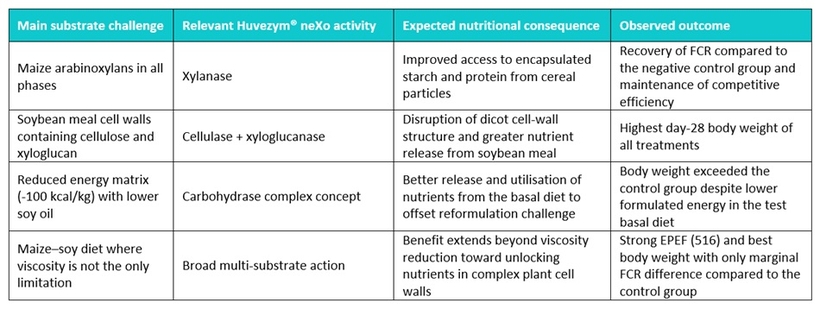
Table 3. Linking diet substrate, enzyme concept and broiler outcome specific to this broiler trial in Jordan
A further point from the trial is that Huvezym® neXo ranked third in terms of European Production Efficiency Factor (EPEF) at 516, while still delivering the highest absolute body weight. This balance between weight gain and efficiency can be commercially relevant. In broiler integrations focused on fixed market age or target weight, the ability to finish heavier birds or reach target weight earlier on a reformulated (and cheaper) diet can be more valuable than a marginal FCR advantage alone. Therefore, the results support that Huvezym® neXo is a reformulation tool as well as an efficient fibre-degrading enzymatic complex, namely in maize-soy diets where xyloglucanase and cellulase contribute with value beyond xylanase activity alone.
Conclusion
The broiler trial shows that Huvezym® neXo can deliver excellent performance on a reformulated maize-soy diet (containing OptiPhos® Plus phytase). Among all the products tested, Huvezym® neXo achieved the highest day-28 body weight, recovered feed conversion relative to the control group and produced a strong EPEF despite the more challenging nutritional specification of the negative control diet. The biological explanation is consistent with the enzyme concept behind the development of Huvezym® neXo: xylanase addresses cereal arabinoxylans, cellulase helps disrupt structural fibre, and xyloglucanase opens soybean (and other protein sources)-derived dicot cell walls. Together, these activities improve nutrient release from maize-soy diets and help broilers to achieve a higher growth potential. On this basis, Huvezym® neXo proved to be a robust enzymatic complex solution for broiler producers aiming to reduce feed costs while maintaining or improving productive performance.