
Miya-Gold® / Top Gut® and Salmonella: From Microbiology To Measurable Impact
Dennis SmuldersSalmonella in swine: prevalence and economic relevance
Salmonella remains one of the most important food-borne pathogens associated with pork production. Across Europe, Salmonella seroprevalence in finishing pigs shows substantial variability between Member States, with reported values ranging from below 0% to nearly 11%, depending on country and sampling matrix1.
Beyond its public-health relevance, Salmonella has a direct economic impact at farm level through reduced performance, increased antimicrobial use, carcass condemnations, and penalties linked to slaughterhouse monitoring programs2. Indirect costs related to biosecurity measures and market restrictions further increase the burden, making Salmonella control a priority for modern swine production systems.
Why butyrate-producing Clostridia matter: insights from Chávez et al., 2016
The importance of gut microbiota composition in Salmonella control was clearly demonstrated by Chávez et al. (2016)3. The authors showed that depletion of butyrate-producing Clostridia resulted in increased epithelial oxygenation, creating conditions that favoured intestinal expansion of Salmonella (Figure 1). Conversely, maintaining or restoring butyrate production contributed to colonisation resistance against Salmonella.
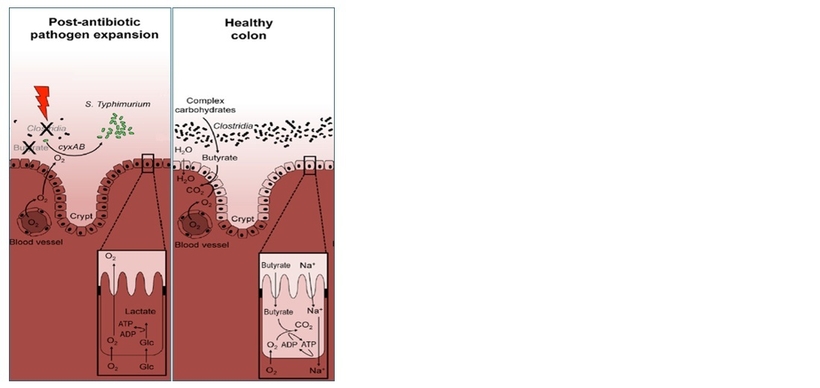
Figure 1. The mitigating effect of butyrate-producing Clostridia on Salmonella in the gastrointestinal tract3
In this context, Clostridium butyricum as a butyrate-producing strict anaerobe, plays a key functional role in maintaining a low oxygen environment in the intestinal lumen of the hind gut. By stimulating epithelial oxygen consumption, it reduces oxygen diffusion into the gut lumen, thereby preserving anaerobic conditions. This is critical, as even small increases in luminal oxygen can give a competitive advantage to facultative anaerobes such as Salmonella. Through this mechanism, C. butyricum helps suppress Salmonella proliferation specifically in the hindgut.
C. butyricum continuously produces butyrate in situ and contributes to a broader microbial network that maintains low redox potential and oxygen pressure over time. As a result, microbial butyrate production is more closely linked to stable colonisation resistance against pathogens such as Salmonella than short-term supplementation of butyrate alone.
Butyrate plays a key role in strengthening the intestinal barrier, supporting epithelial integrity, and modulating local immune responses, thereby creating a gut environment that is less favourable for Salmonella survival and proliferation3,4. Miya-Gold®/Top Gut®, a probiotic based on Clostridium butyricum, fits within this biological concept by supporting endogenous butyrate production directly in the intestinal tract. In contrast to exogenously added butyrates in feed, which are partially absorbed or metabolised before reaching the distal gut, ensuring a more sustained and physiologically relevant supply. Moreover, this approach is inherently linked to microbiota modulation, combining butyrate production with competitive exclusion and stabilisation of the microbial ecosystem. This results in a more durable effect on gut health compared to the transient action of supplemented butyrates alone. These findings support the concept that targeted modulation of the gut microbiota using butyrate-producing probiotics can be an effective strategy to mitigate Salmonella at herd level.
Miya-Gold®/Top Gut®: consistent Salmonella mitigation under field conditions
This microbiological concept is strongly supported by Huvepharma®'s growing body of field data. A recent meta-analysis of five Danish commercial trials demonstrated that supplementation with Miya-Gold®/Top Gut® (a Clostridium butyricum based probiotic) during the grower-finisher phase resulted in a 45% reduction in Salmonella seroprevalence, measured at slaughter (Figure 2).
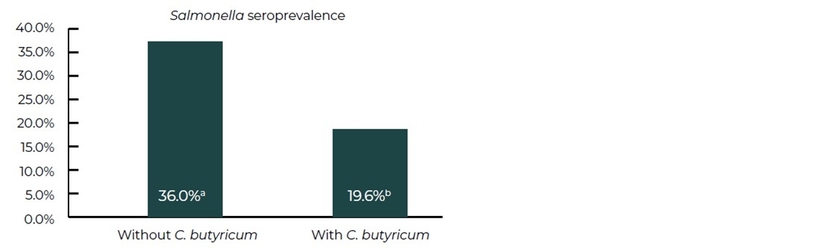
Figure 2. Salmonella seroprevalence at slaughter before and after Miya-Gold® supplementation. Different superscripts (a,b) indicate a significant difference at p<0.001
Importantly, this effect was consistent across all farms, despite differences in management, herd size, and baseline infection pressure, highlighting the robustness of the approach under practical production conditions. All details of this meta-analysis can be found in TB10 linked below.
In total, seven technical bulletins are available on Salmonella mitigation with Miya-Gold®/Top Gut®, covering different production stages and commercial settings.
TB03 - Miya-Gold® reduces clinical Salmonella in weaned piglets
TB04 - Miya-Gold® from birth to growing decreases Salmonella-positive fatteners
TB04 - Miya-Gold® supplementation in piglets on Salmonella challenge
TB05 - Miya-Gold® reduces Salmonella under commercial conditions in fatteners
TB10 - Miya-Gold® reduces Salmonella seroprevalence in fattening pigs
TB11 - Miya-Gold® supplementation reduces antimicrobial consumption in piglets